
Journey into strategy (Moving Brands)
Part 2: Moving Brands

I was hired by Ben Wolstenholme, the co-founder and CEO of Moving Brands, on the same evening Barack Obama was sworn in for his first term as President. And, even though it was a miserable, rainy night in January in Shoreditch, the air felt full of excitement and positivity. It felt like things were going to be alright.
The important thing to remember about my time at Moving Brands – which was a massive turning point in my career – is that I was in my mid-20’s. For almost everyone, this is a life stage when the going is good. You’re young, you’re free, you’re determined, your skin is bouncy, you know enough but not too much, you don’t know much but you know enough, you can eat a burger for lunch and feel fine all afternoon. It’s brilliant. So, yes I was powering up in my career but I also want to ensure that the story of this chapter isn’t told through rose-tinted glasses or focuses purely on things that most people experience in their 20’s.
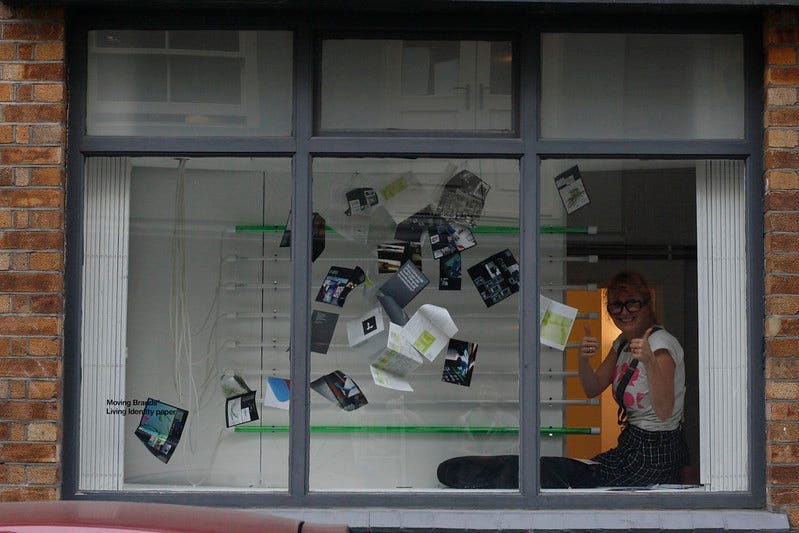
Perhaps the best way ‘in’ is to repeat something one of the founders said to me when I’d been there a few years. It was late at night, and we’d all been drinking, but he said, “There’s about 200 great graphic designers in the world, and about 150 of them have worked at Moving Brands at some point in their careers”. Hyperbole aside, it’s true that the calibre of the designers that passed through Moving Brands was absolutely exceptional and, as a fledgling strategist, the chance to work alongside them was totally glorious. Their talent and responses to the world opened my mind in ways that went beyond everything I had ever experienced. I fell in love with design, designers and the design world so deeply that I built my entire existence at that time around crafting strategies – and tweets on behalf of the MB Twitter account – that fuelled, fed and upheld it all.
Grasping every opportunity thrown my way, I wrote brand narratives, campaign copy and film scripts for the likes of Sam Bebbington (now Creative Director at Apple), Marian Chiao (now Creative Director at OpenAI), Lisa Smith (now Global Chief Design Officer at Uncommon Creative Studio), Ben Atkins (now the founder of Any Other Name), Terry Stephens (now the founder of Nomad Studio), Rex McWhirter (now the founder and Director of Photography at Oldie Films) and Jack Laurance (now Global Vice President, Creative at Mandarin Oriental Hotel Group). To call out just a few and missing many, many other talented individuals still doing brilliant work across the world. I may have been inexperienced, but what I lacked in expertise I tried to make up for in enthusiasm and dedication to my colleagues.
I remember being teased by my team for finishing up a kick-off workshop with a tech startup and declaring it "one of the best days of my life". But sitting in that room, surrounded by people who were totally committed to inventing something new on the client side, and completely capable of making it all feel exciting yet tangible on the creative side – it was the sort of ‘work’ that never felt like ‘work’.
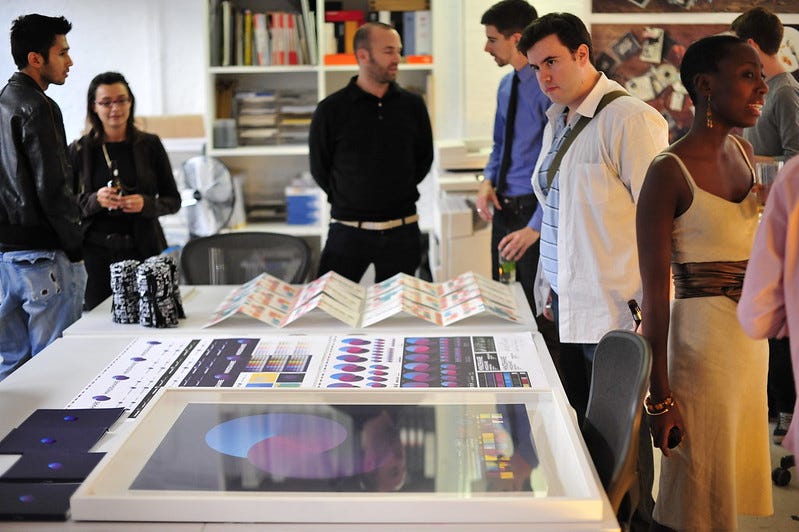
Random snapshots from that time flood back: the controversial Twitter campaign for our 'Brand For London' pitch to the Greater London Authority1; Monica Lewinsky interviewing for a researcher role2; arguing with Jonathan Ellery about whether the Swisscom logo was any good3; presenting at the world's first (and probably last) augmented reality conference only to have the tech fail at the last minute; visiting clients around the world, from a Northampton shoe-making factory to a 'hacker house' in Palo Alto; staying for two weeks in the completely empty San Francisco home of one of the founders before he moved in4; literally begging a creative director to release me from a late-night client call so I could go on a date5; Christmas parties that were not only held in January but became so raucous that bones were broken and people went AWOL; the comforting darkness of the edit suite after hours.
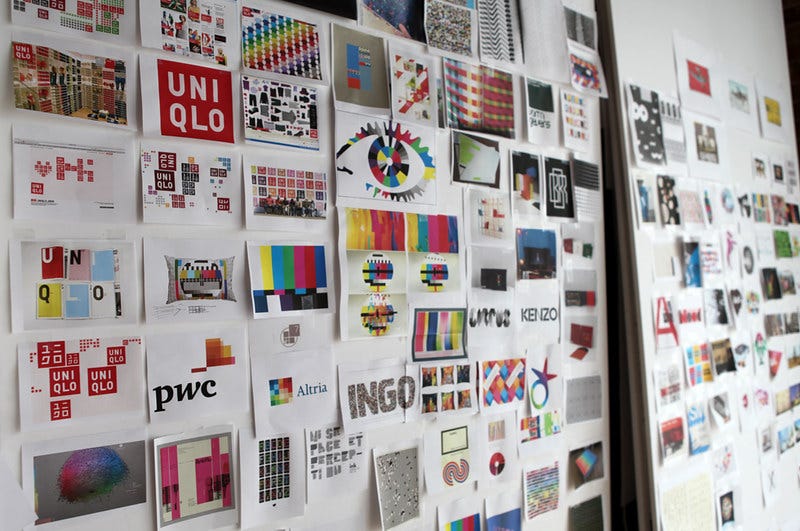
Unlike its distinctly black and white logo, Moving Brands occupied a grey zone culturally. It wasn’t a bad place, but it wasn’t exactly a good place either. The talent, craft and ambition was undeniable, and the clients they were landing in the 2010’s weren’t just household names but genuinely innovative, world-shifting brands. From the way they set up a meeting room (5-inch pile of A3 paper, black Sharpies at 45 degrees), to the way they honed presentations (vast boards with entire decks printed out and pinned up neatly ready to be discussed and debated as a team), to the investments they made in new technology, there was a finesse and curiosity that was compelling and addictive. Yet there were problems, the extent of which only came out very recently, but which you could sense in the air and in the walls even then.
That feeling that an agency could have a personality that was somehow distinct from the sum of its parts is something I’ve come to believe is important to pay close attention to. It’s what I find myself talking about when people ask my advice on joining this or that agency, or about getting into or leaving the agency world. Every agency is different and special and frustrating in its own ways. And it’s not just “culture” in the HR, posters-in-the-loo sense, it’s something more fundamental than that because identity design may be a commercial enterprise, but it's one built on ideas, artistry and optimism for what’s possible through creativity. I loved Moving Brands so much, I showed up for it, I travelled the world with it, I defended it when it came under fire. But it ended up breaking my heart. And others too it turned out.
There came a point where I realised that without other strategists around and above me, I wasn’t going to progress. Moving Brands had taught me the magic of working alongside the best of the best when it came to designers, and now I wanted some of that in my own practice as well. And it had taught me it might be time to be somewhere with more structure and accountability, somewhere more grown-up. So I set my sights on Wolff Olins – the OG, the Daddy, the Big Guns of branding, and after 18 months and 15 interviews in two countries, it didn’t happen. Until it did.
Kill: Google search results autofill
Marry: “One studio, three locations” - when it worked, it really worked.
Snog: Skinny jeans and a pair of Trickers.
Were you one of the “150” who passed through MB’s doors? I’d love to hear your happy mems in the comments.
See you next week for Part Three: Wolff Olins in which I learn the power of a cracking brand framework and everyone ate a lot of pan fried scallops at lunch.
All images sourced from the Moving Brands Flickr account. I think most of the photos were taken by Adam Laycock and MB employees.
Lost the pitch.
Didn’t get the job. No pun intended.
Still stands. It’s a great logo.
Literally slept under a towel.
Made it to London Fields for 8pm.
4 years of blood sweat and occasional tears. Forever an ex-MBer. Forever in your debt for the introduction!
If you could survive, even thrive, through the smog of occasional toxicity, you came out the other side in far better shape than you went in.
Feels dirty to say the ends justified the means in this day and age, but I firmly believe that the borderline fascist approach to craft, excellence and creative thinking pushed everyone and everything to its limits and left me with a career long bar to which everything since is measured.
This was a brilliant read. Thank you. I did a six month stint towards the end (?) of MB’s London presence. Some of the most talented design folk I’d ever met, even when it felt like things were getting… weird…