
Nubs
Rethinking singularity in brand strategy

When I think about the way people praise strategists and their work, it’s so often along themes of clarification and simplification. They admire their ability to drill down to what’s important, to cut through the noise, and to bring many ideas together into one, single message. Singularity - that seems to be what people – clients – want from the strategists they engage.
I am no stranger to this expectation, and yet the past 18 months of projects have been characterised by companies which possess a duality. A corporate real estate business that serves the sometimes-conflicting needs of both tenants and landlords. A security company that is both people-led and technology-driven. An independent school that’s as focused on results as it is on each individual student. A finance comparison platform that’s growing its B2B offering but still wants to be a consumer-first brand. A private members club that aspires to the new, whilst never forgetting where it came from.
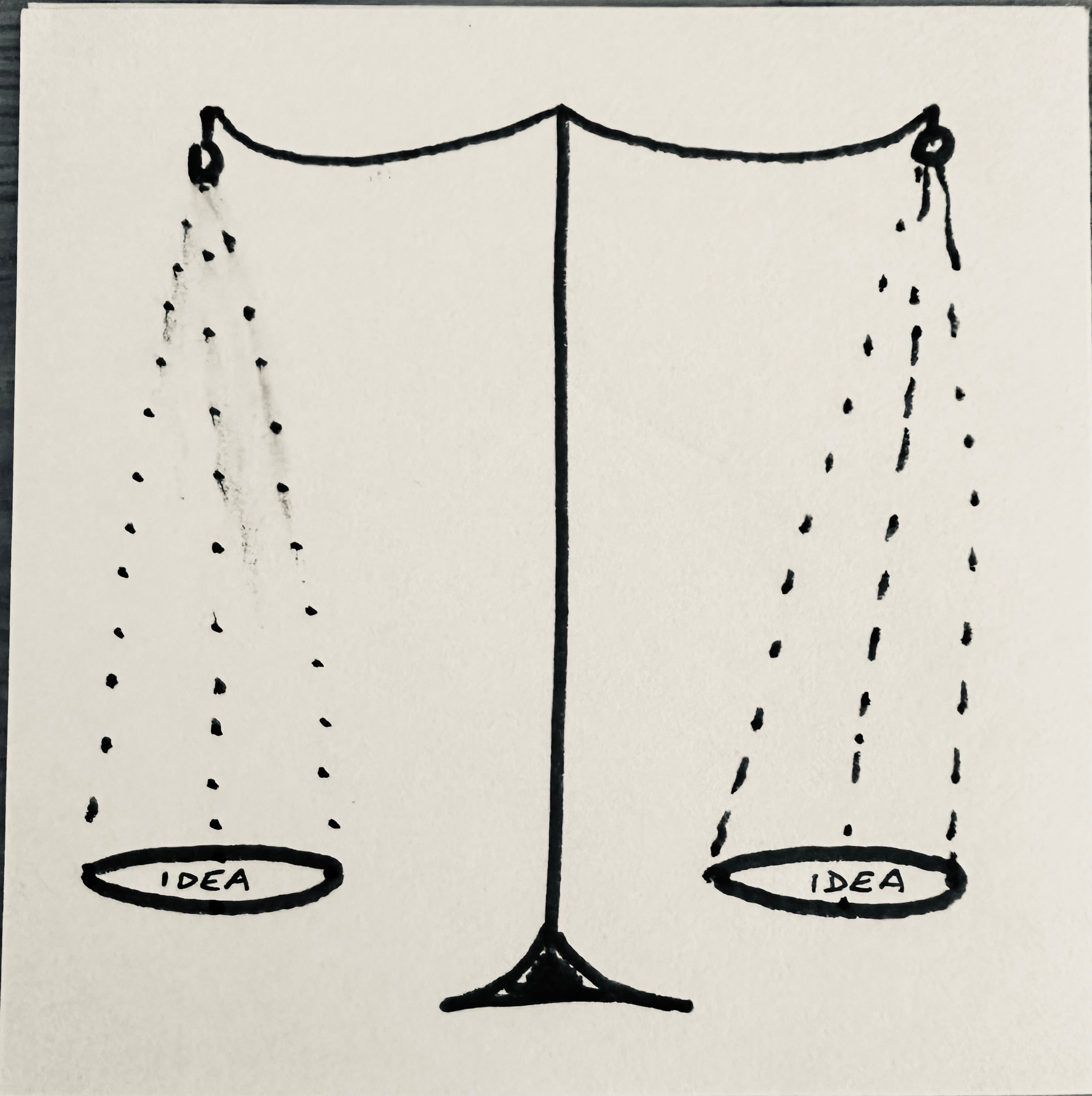
In every case, the brief was never about prioritisation – of making an informed decision about which concept should lead. It was only ever about finding and defining a state of balance, equality and co-existence between two disparate concepts. And it’s difficult, it’s why they sought outside help to try and figure it out. As a strategist raised on The Big Idea, I arrive at every strategic challenge with the belief that a single, clear unifying idea is not only possible, but critical. I, along with all my ancestrategists, seek to find power, strength and alignment in the nub. Not nubs. Ew.
But to have such a spate of briefs dead set on achieving a “Spice Girl” aka making two concepts become one, I have to wonder if something’s changing. Just as visual identity is no longer confined to a set of stationery and a brochure, maybe strategy can no longer aspire to be minimal? Maybe late-late stage capitalism renders The Big Idea overly simplified? What if the job is not to attempt to resolve a contradiction, but to recognise and organise it?
I’m loath to reference an advertising campaign, because we all know that brand people hate ad people. But I find myself thinking of the Bic EZ Reach lighter campaign featuring Martha Stewart and Snoop Dogg. It’s a perfect example of a company that refused to pick a side. In deciding whether to lean into wholesome domesticity or stoner culture, the powers that be decided not to decide. Instead, they took two contradictory personalities – who, incidentally, had already cemented their influence as a duo – and managed to make a utility lighter feel equally at home beside both a scented candle and a bong. It would have been so easy, and yet so boring, to land somewhere like “accessible sophistication”, but instead they made the inherent tension the very thing that makes it memorable.

As strategists we are trained in the mantra that ambiguity is failure. We must find the point and then get to it as quickly as possible. It’s about the destination, not the journey. And it’s why so many strategists are total weirdos - because we’re like this in our real lives as well. We’re blunt, decisive, and unambiguous about everything from a friend’s quirky new haircut to the way we navigate Sainsbury’s. But just because we want the world – and the businesses that operate in it – to be orderly, doesn’t mean it is or they are.
Certainly my fore-strategists may have been able to achieve the modernist ideal of a singular narrative. But it was born out of a time when companies themselves were also a little simpler, and when coherence and consistency mattered far more than adaptability. Media channels were posters, TV and radio ads, and direct mail. And categories were stable, unwavering. I’m recalling that infographic that shows the top 50 from the Fortune 500 over time, and the fact that in 1990, the average tenure in the 500 was 20 years, whilst now it is just 14.
Today’s organisations are messy b*tches. Running a finger down my recent client list, we’re looking at companies that are the product of mergers, like the corporate real estate agency; or companies that must constantly innovate if they are to ensure safety, like the security firm; or academic institutions that must speak to students who pick based on TikTok videos, their parents who want a guaranteed Oxbridge place, and their grandparents who are paying the fees, like the school; or companies that need to pivot to enterprise solutions as GEO eats their SEO lunch, like the finance comparison platform; or companies that need to make new money feel like old money, like the members clubs. In all of these instances, I’ve fought for distillation but often had to settle for containment. For balance.
And maybe that’s ok. Concepts like The Big Idea are still worth aspiring to – like a beautifully minimalist house where everything has a place and everything is in its place. But we, as strategists, must also be content with working in the day-to-day – a happy home where life unfolds and things aren’t always where you left them. In my work, this has meant less pondering the foundational “why?” and more fine-tuning of the actionable “what?”. I’ve accepted that there might not be a one-size-fits-all value proposition, and created sets of propositions for different audiences. Or I’ve mapped multiple, disparate competitor sets to find hidden commonalities. After all, the strategist’s toolbox – the concepts, frameworks, language and terminology – is there to support the needs of the work, not make it a box -icking exercise.
And my clients? They may not get the singularity they imagined, but they have generally come to recognise that the most honest and useful thing a strategist can do is not simply point at a North Star, but cut a series of paths through the mess and noise that helps them get there.
Lately I’ve been:
Reading Devil In The White City. It’s about the Chicago World’s Fair in 1983, the man who created it and the man who used it as his hunting ground.
Digitising over ten years’ worth of family home videos. 43 mini-VHS tapes have just gone off to Digital Converters. I await the results, the laughs and the inevitable re-traumatisation.
Leaving my immediate postcode. By April this year, I’d had the opportunity to travel to Lisbon, Tokyo and Paris. It felt so good to have such a burst of new inputs and the chance to connect with other ways of being.
Wondering if anyone in my network – yes, that’s you – knows anything about sponsorship or is looking to sponsor content that’s created for this audience. It’s not for Substack, but another idea I’m working on. Please ping me if so.
That’s all folks. Cx